The Evolution of Homebrew Computing: Capacitor-Based Memory in a Relay Computer
In recent years, homebrew computing has experienced a resurgence in popularity, with enthusiasts around the world building their own computers using a wide range of components and technologies. One project that stands out for its ingenuity is [DiPDoT]'s relay-based computer, which has recently been upgraded to use historically-plausible capacitor-based memory. This update takes this impressive device to new heights, making it a must-see for anyone interested in the history of computing and the evolution of homebrew hardware.
The story begins with the choice of memory type for [DiPDoT]'s relay computer. With CRTs (cathode ray tubes) no longer readily available due to their toxicity, mercury delay lines posing an obvious challenge due to safety concerns, and core rope memory requiring advanced threading skills, it's clear that [DiPDoT] had to get creative. They ultimately opted for mechanical or electromechanical memory, which in this case took the form of capacitors. By using capacitors as memory, [DiPDoT] was able to store binary data in a way that is both historically accurate and surprisingly effective.
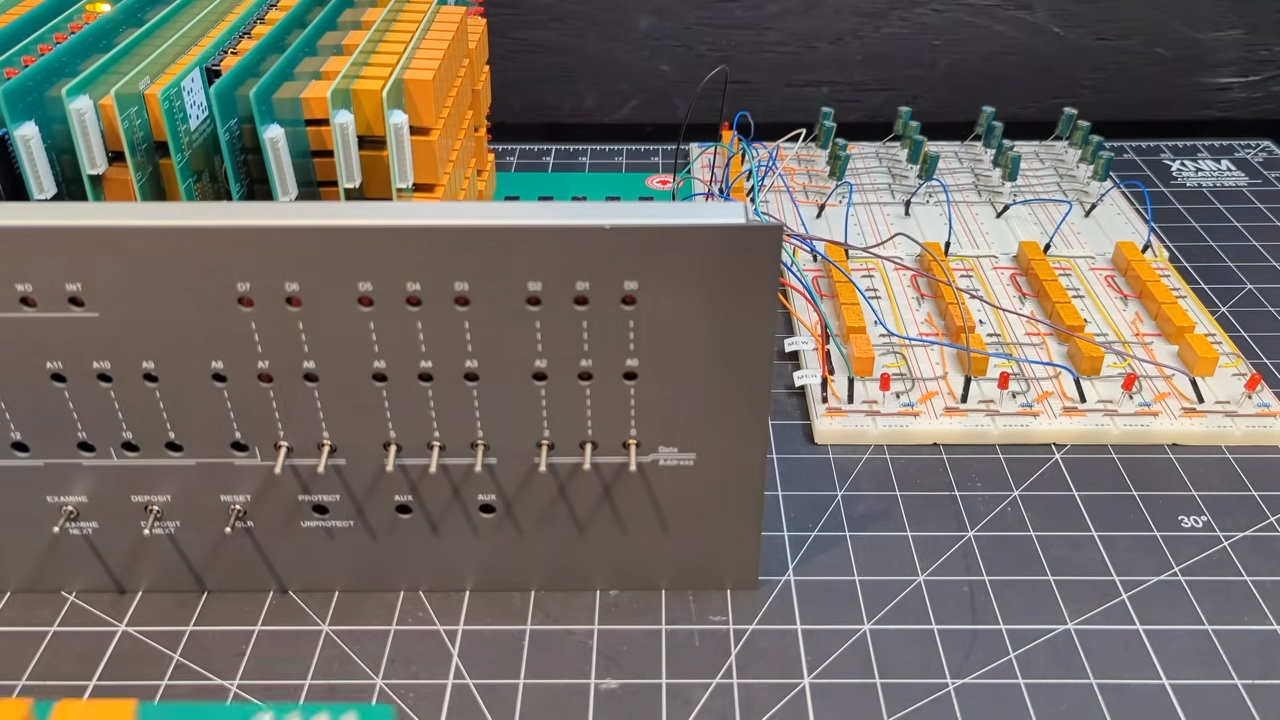
The use of capacitors as memory is based on a simple yet elegant principle: charged/discharged capacitors can be used to represent binary data. With a capacitor fully charged representing a '1' and discharged representing a '0', it's clear why this technology would have been attractive to early computer designers. However, as with many early computing technologies, there are drawbacks to using capacitors for memory. Specifically, it's not possible to overwrite a '1' with a '0' without first clearing the capacitor. This limitation is addressed by [DiPDoT]'s auto-clearing memory circuit, which uses three relays and a single capacitor to clear the data when necessary.
Addressing another challenge of early computing technology, [DiPDoT] uses modern diodes to address the memory locations, which is an interesting compromise between historical accuracy and practicality. Furthermore, LEDs are used instead of incandescent indicator lamps to reduce power consumption, demonstrating a keen understanding of energy efficiency in vintage computing.
The real pièce de résistance of this project is the demonstration of [DiPDoT]'s circuit on breadboard, showcasing the capabilities of capacitor-based memory in a relay computer. The video begins with a 4-bit word and gradually scales up to demonstrate a 16-bit program, before finally showcasing an 8-byte program that runs at the end of the video. This is a remarkable achievement, not just for its technical complexity but also for the sheer joy of watching a computer program run on a vintage hardware platform.
In conclusion, [DiPDoT]'s relay-based computer with capacitor-based memory is a testament to the power of innovation and creativity in homebrew computing. By embracing historically-plausible components and technologies, they have created something truly unique and special. Whether you're a seasoned hacker or simply interested in the history of computing, this project is sure to captivate and inspire.
Keywords: capacitor-based memory, relay computer, homebrew computing, vintage technology, modern hacking, cybersecurity, data breach, malware, vulnerability, AMSR (Asynchronous Memory Storage Relay).