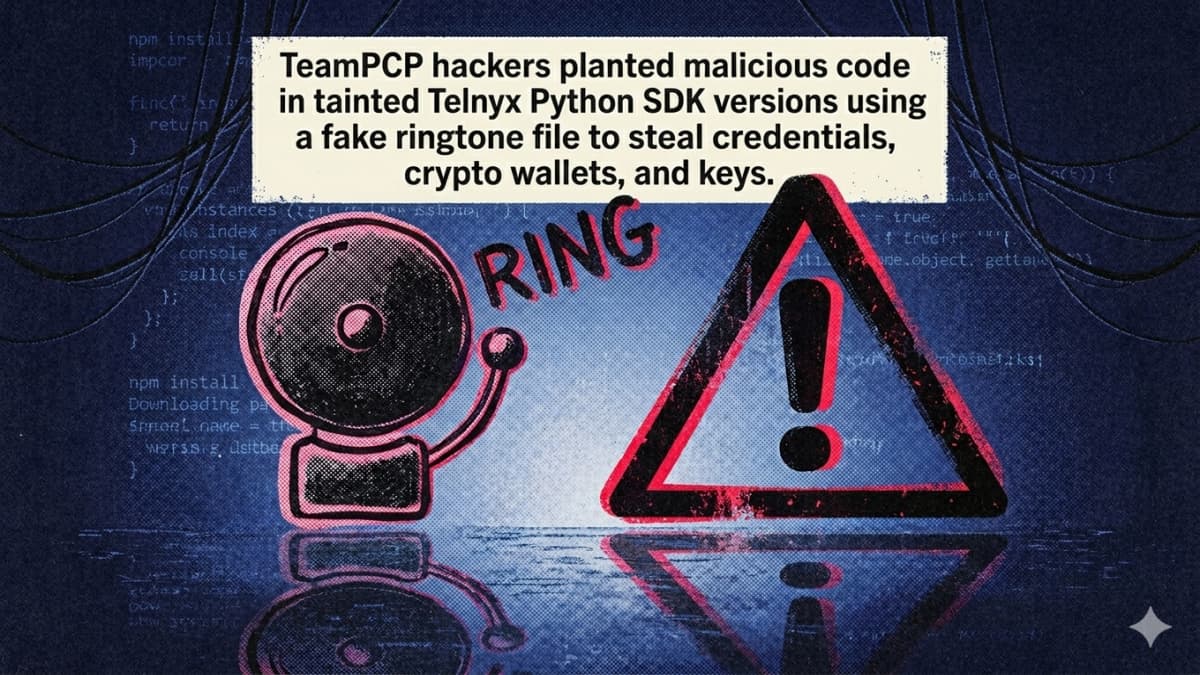
**TeamPCP Utilizes Malicious Tactics to Exfiltrate Sensitive Data**
In a disturbing revelation, researchers have uncovered the modus operandi of TeamPCP, a group infamous for its malicious activities. According to recent findings, this notorious hacking collective employed a deceitful tactic to pilfer sensitive credentials from unsuspecting users. The operation leveraged a tainted Telnyx software development kit (SDK) that masqueraded as a harmless ringtone file, cleverly concealing the true intentions of the attackers.
**The Malicious SDK: A Masterclass in Deception**
Telnyx, a telecommunications company, unwittingly distributed an infected SDK to its clients. The malicious package contained a fake ringtone file (named "ringtone.mp3") that served as a Trojan horse, allowing TeamPCP to gain unauthorized access to the systems of unsuspecting users. Once executed, the tainted SDK launched a sophisticated malware campaign designed to exfiltrate sensitive data.
Researchers have identified Qilin Ransomware as the primary payload responsible for this heinous operation. This malware has undergone significant upgrades since its initial discovery, allowing it to adapt and evolve in response to changing threat landscapes. A notable feature of the upgraded Qilin Ransomware is its ability to target Google Chrome credentials, compromising user authentication and enabling malicious actors to assume control over affected systems.
**Data Exfiltration via Credential Theft**
The tainted SDK utilized a cunning approach to steal sensitive data from compromised systems. By masquerading as a legitimate ringtone file, the malware successfully bypassed many security measures designed to detect and prevent such attacks. Once inside, the Qilin Ransomware leveraged advanced techniques to extract Google Chrome credentials, rendering affected users vulnerable to identity theft and subsequent exploitation.
**The Risks of Tainted SDKs and Malicious Software**
This incident serves as a stark reminder of the importance of vigilance in the cybersecurity realm. Tainted software development kits (SDKs) pose a significant threat to organizations relying on third-party code for their products or services. In this instance, Telnyx's unwitting distribution of an infected SDK had far-reaching consequences, exposing countless users to potential data breaches and malicious activity.
**Conclusion: Staying Ahead of the Curve in Cybersecurity**
The rise of sophisticated malware like Qilin Ransomware underscores the need for continuous education and awareness within the cybersecurity community. It is imperative that organizations prioritize robust security measures, including regular software updates, penetration testing, and employee training programs. By staying informed about emerging threats and vulnerabilities, we can work together to mitigate the impact of malicious activities such as those perpetrated by TeamPCP.
**Recommendations:**
* Regularly update and patch software development kits (SDKs) and third-party code. * Implement robust security measures, including penetration testing and employee training programs. * Stay informed about emerging threats and vulnerabilities through industry research and collaboration.
By acknowledging the cunning tactics employed by malicious actors like TeamPCP, we can fortify our defenses against these threats and ensure a safer online environment for all.