# SSH-MITM v6.0.0: The Ultimate Guide to Intercepting SSH Sessions for Authorized Audits
In the world of cybersecurity, authorized penetration testing often requires tools that can see inside encrypted tunnels. The release of SSH-MITM v6.0.0 delivers a powerful new interactive SSH interception tool that lets security researchers intercept sessions, monitor live traffic, inject commands, and even manipulate file transfers in real time. Designed specifically for authorized security audits and penetration testing, this updated version introduces enhanced features for auditing SSH client behavior, including new capabilities for testing FIDO2 hardware token vulnerabilities.
## A New Era in SSH Auditing Tools
When conducting authorized security audits, having visibility into the encrypted SSH channel is essential. SSH-MITM acts as a man-in-the-middle proxy that sits between an SSH client and its server, terminating both sides independently while forwarding all traffic. This unique position gives the auditor full visibility and control over the connection without either endpoint realizing the interception has occurred.
The tool was originally developed to investigate a fundamental weakness in how SSH clients handle hardware token authentication. This research uncovered that FIDO2 tokens, commonly used as a second factor for secure authentication, can be phished through a technique called trivial authentication. This vulnerability exploit is particularly concerning because attackers can force SSH clients into using a trivial authentication method—such as keyboard-interactive with no prompts—which effectively grants access without any genuine authentication. The hardware token protection is completely bypassed because the token is never actually challenged.
## Getting Started with SSH-MITM
One of the most appealing aspects of SSH-MITM v6.0.0 is its simplicity. Unlike traditional hacking tools that require complex installation procedures, SSH-MITM requires no installation at all. Simply download the AppImage and immediately begin your authorized security assessment. For those who prefer alternative deployment methods, the tool also supports installation via pip, Flatpak, and Snap, though the PyPI release may lag behind the latest version. To get immediate access to the interactive tutorial and all recent improvements, direct installation from GitHub is recommended.
For newcomers to the tool, the built-in interactive tutorial is an excellent starting point. This browser-based, step-by-step guide requires no target server to get started. The tutorial follows five chapters that mirror an authorized assessment of a fictional company called Logfile Inc. Users will learn about password interception, public-key authentication handling, SFTP transfer monitoring, command execution, and live session mirroring—all in a controlled, legal testing environment.
## Intercepting SSH Credentials and Sessions
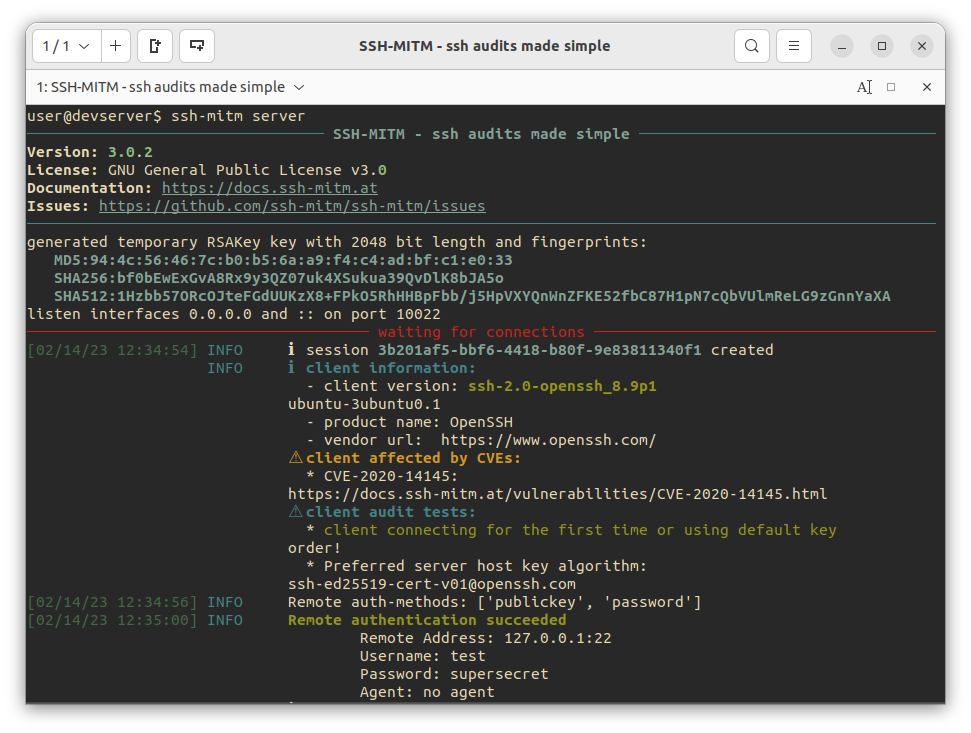
The core functionality of SSH-MITM involves pointing the tool at a target host that you're authorized to test. Once configured, simply have the SSH client connect through SSH-MITM on port 10022 rather than the standard SSH port. The interception catches the session immediately and logs credentials as they're entered, giving auditors real-time access to authentication data.
For every intercepted connection, SSH-MITM opens what's called a mirror shell on a local port. By connecting to this mirror shell from a separate terminal, auditors can observe the user's activity in real time. This cybersecurity research capability extends beyond passive observation—the auditor can inject commands independently without affecting the original connection. This allows for sophisticated security testing scenarios where testers can simulate various attack vectors while monitoring how the system responds.
## Seven Vulnerabilities Discovered
Operating from the man-in-the-middle position makes it possible to observe SSH client behavior that remains invisible from either endpoint. This unique vantage point has proven incredibly valuable for vulnerability research. SSH-MITM has been instrumental in discovering seven previously unknown vulnerabilities in widely-deployed SSH software.
The most recent discovery concerns CVE-2026-60000, a critical vulnerability in OpenSSH's GSSAPI authentication that violated RFC 4462 standards. This hacking vulnerability allowed attackers to bypass MaxAuthTries entirely, creating a pre-authentication denial of service condition. The same root cause also produced a username validity oracle and a privileged-process crash, all of which were fixed in OpenSSH 10.4. This research has been presented at security conferences, including a detailed talk at DeepSec 2021, demonstrating the ongoing importance of understanding and mitigating SSH vulnerabilities.
## Real Security Research and Legitimate Use
It's crucial to emphasize that SSH-MITM is intended exclusively for authorized security audits, penetration testing, and research purposes. The tool comes with a clear legal notice: do not use it against systems you do not own or lack explicit written permission to test. Unauthorized interception of SSH traffic may be illegal in various jurisdictions, and security researchers must always operate within legal boundaries.
Not every result of the research conducted with SSH-MITM is a vulnerability—the project has also contributed hardening fixes directly to OpenSSH as part of its upstream contributions. This commitment to improving overall cybersecurity infrastructure is commendable and demonstrates the dual nature of security research: identifying weaknesses while also strengthening defenses.
## Installation Options
For those ready to begin authorized security testing, the installation process is straightforward. The AppImage download provides a click-and-run solution that works across most Linux distributions. Alternatively, the pip package offers Python integration, while Flatpak and Snap versions provide additional package management options. The project welcomes contributions from the security community, with detailed contribution guidelines available for developers interested in improving the tool.
## Conclusion
SSH-MITM v6.0.0 represents a significant advancement in authorized SSH auditing capabilities. Whether you're conducting penetration testing, investigating potential data breach vectors, or researching the latest malware-like exploitation techniques in SSH implementations, this tool provides the visibility and control necessary for thorough security analysis. By combining an intuitive interface with powerful interception capabilities, SSH-MITM has become an essential asset for cybersecurity professionals dedicated to finding and fixing vulnerabilities before malicious actors can exploit them.
The release of this tool, with its focus on FIDO2 token vulnerabilities and SSH client behavior analysis, reminds us that even trusted authentication methods can harbor weaknesses. For authorized security researchers pushing the boundaries of what's discoverable in SSH implementations, SSH-MITM v6.0.0 offers a powerful, legal, and education-focused approach to understanding and improving security posture across networks and systems.