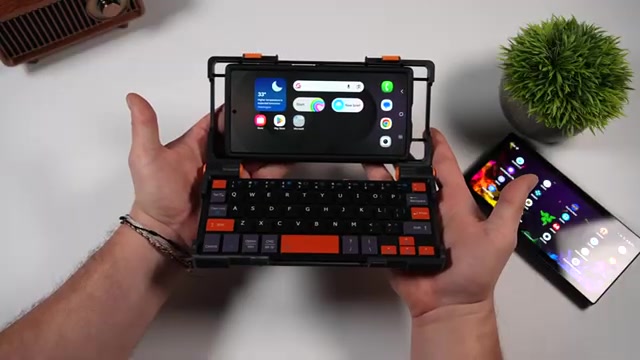
The Razer Edge Cyberdeck: A Brilliant Example of Composition
The Razer Edge Cyberdeck is an innovative repurposing project that transforms an older handheld device into a compact, functional workstation with a few cheap parts and some plastic. This clever hack leverages ecosystem leverage, not the device's raw performance, to deliver functionality beyond what its local hardware can sustain.
The most interesting aspect of this build is not the gadgetry itself but rather the idea behind it: taking an older Android handheld and turning it into a portable, magnetic pocket rig for gaming, emulation, and light productivity. This concept reveals a practical path for anyone with a spare device to turn it into a flexible, portable workstation.
Two practical constraints shape everything that follows in this project. One is software: the Razer Edge ships with Android 12, which limits built-in terminal and Linux integration compared to newer Android versions. The other constraint is raw performance: the Snapdragon G3X Gen1 chipset and 6 or 8 gigabyte RAM ceiling set expectations for local emulation and native PC workloads.
The part that changes how this should be understood is the fact that the project succeeds when cloud gaming, clever mounting, and 3D printed ergonomics carry the load. It becomes fragile when you expect flagship-level local emulation or seamless Linux installs without extra work.
The Parts And Why They Matter
A Razer Edge Cyberdeck is assembled from three practical building blocks: a low-cost Razer Edge handheld, a compact Bluetooth keyboard, and a 3D printed clamshell paired with a magnetic adapter. This combination emphasizes portability and modularity, shifting heavier workloads to cloud services while preserving short writing and local emulation use cases.
ETA Prime started with a Razer Edge, a handheld that shipped with a detachable controller and the Snapdragon G3X Gen1 chipset. At launch, it was presented as a gaming handheld with cloud gaming in mind. Today, the same hardware has aged into a bargain if you can source one used. In the documented build, the device was purchased on a marketplace for about $80 without the original controller.
The price point matters because it reframes the project. For under a hundred dollars for the core device, you can add modest peripherals and a 3D printed shell and end up with a capable travel rig. The build suits users willing to accept some setup work and occasional troubleshooting to gain a magnetic pocket workstation on the cheap.
How Does It Work?
The Razer Edge Cyberdeck uses an OSNAP MagSafe adapter with an adhesive metal ring attached to the Edge and a metal plate inside the 3D printed case. The magnet and plate provide a removable, non-destructive magnetic interface. This creative solution allows users to mount their handheld in different configurations.
ETA Prime also left the door open for future iterations, mentioning that if the Linux desktop experiment fully succeeds, it could apply to many other Android devices. This approach only works within a narrow software window when the device either supports modern Android features or when the builder is prepared to accept partial Linux installs and the troubleshooting they require.
Who Is It For?
The Razer Edge Cyberdeck is for tinkerers, budget-minded travelers, and anyone who values portability and modularity over raw local performance. It's a great option for users willing to invest some time in setup and potential troubleshooting but want a low-cost, versatile travel rig.
Limitations And Conclusion
The Razer Edge Cyberdeck is not a perfect replacement for a high-end laptop or a modern flagship handheld. However, it serves as a calculated repurposing where the constraints are visible and manageable. For those who value portability and flexibility over raw local performance, this project is compelling.
Where can you find the 3D model used in the build? The base palm top model is available on Printables from a user named S. Gordienko. It includes phone inserts and a palm-top design that was adapted for the Razer Edge in the documented build. This project highlights a broader pattern in consumer technology: devices age into opportunity.
As cloud gaming and efficient app ecosystems evolve, the threshold for utility will shift. The Razer Edge Cyberdeck is both a snapshot of a current technique and a prototype for what happens when older hardware is given a second life through clever design and modest expense.