lure v0.7.1: Local Linux Binary Analysis Just Got ARM64 Support (Zero Cloud, Zero Root)
The security research community has been buzzing about "lure" — a local-first Linux binary analysis tool that promises to let you see exactly what an ELF executable does before you run it, without sending a single byte to the cloud. The release of lure v0.7.1 is a significant milestone, adding full ARM64 binary support via QEMU user-mode emulation. For security researchers, reverse engineers, and CTF players who prioritize privacy and operational security, this update solidifies lure's position as an indispensable utility in the local malware analysis arsenal.
A Sandbox That Respects Your Privacy
In an era where "cybersecurity" often involves uploading suspicious samples to third-party services, lure takes a radically different approach. The tool operates entirely on your local Linux machine. There is no cloud component, no telemetry, and no hidden backend that receives your sample files or generated reports. This "zero cloud" philosophy is critical for handling sensitive malware samples where the very act of uploading them to a public scanner could leak intelligence about a targeted attack.
Furthermore, lure operates with "zero root." You don't need to elevate privileges or run the tool as root to get deep behavioral insights into a binary. This is a massive win for security researchers who are wary of running potentially malicious code with elevated privileges on their primary workstations. By combining static ELF inspection with dynamic behavioral execution analysis, lure provides a comprehensive overview of a binary's intentions without requiring a full hypervisor or a dedicated heavy-weight sandbox environment.
What Does lure v0.7.1 Actually Do?
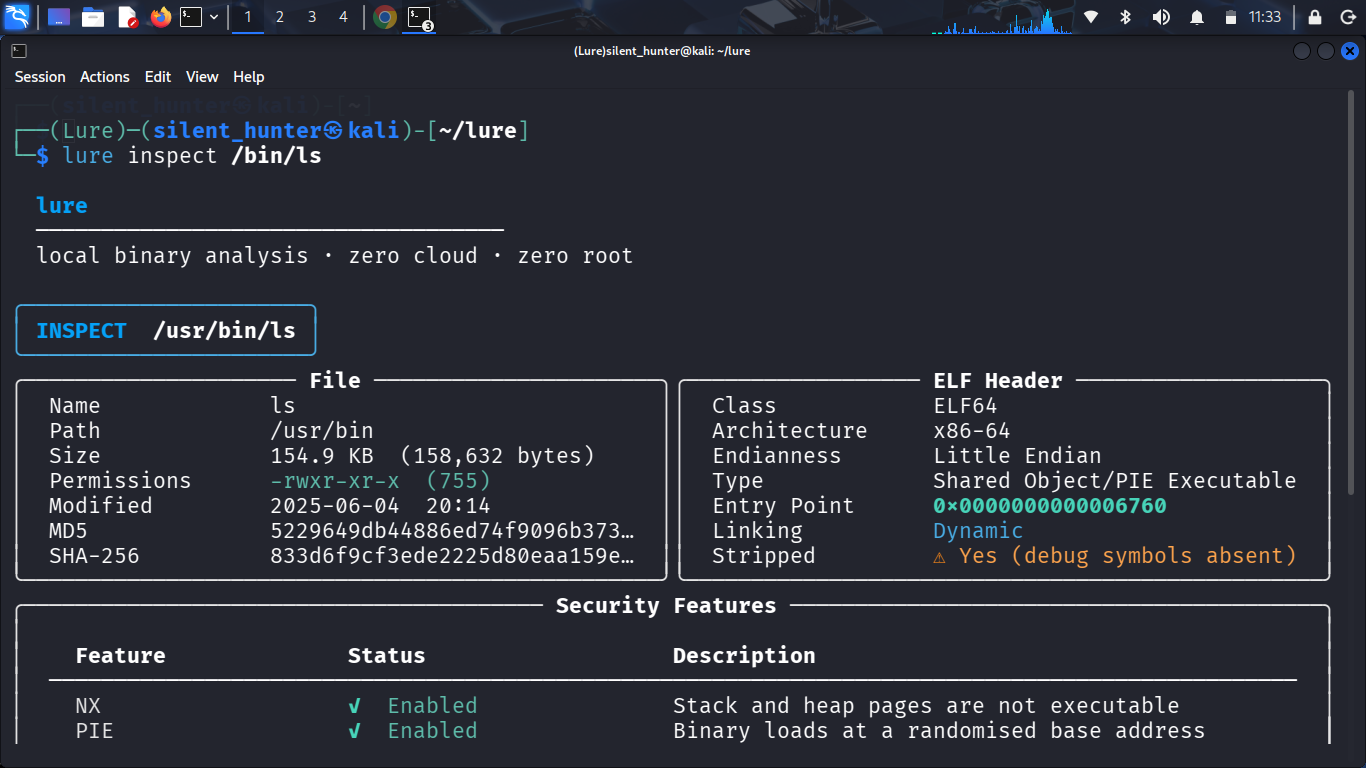
The core value proposition of lure is its dual-analysis engine. First, it performs static inspection—examining the ELF headers, imported functions, and strings without ever executing the file. This initial step often reveals immediate red flags, such as suspicious system calls or references to known malicious URLs. The second pillar is behavioral execution analysis. Here, lure runs the binary in a constrained environment, monitoring its actions in real-time. It meticulously logs what files the binary accesses, what network connections it attempts (though network access is blocked by default), and what child processes it spawns.
This data is then aggregated into a classification verdict, which is presented in three tiers: CLEAN, SUSPICIOUS, and DANGEROUS. This heuristic approach allows researchers to quickly triage files—prioritizing the DANGEROUS ones for deeper manual reverse engineering. It’s a workflow that saves hours of time when dealing with large batches of potentially hostile files.
The Big Update: ARM64 Support via QEMU
Traditionally, many analysis tools were pigeonholed into x86-64 architectures. However, the rapid proliferation of ARM-based servers, edge devices, and mobile hardware has made ARM64 ELF binaries a common sight in the wild. lure v0.7.1 directly addresses this shift by introducing support for ARM64 binaries via QEMU user-mode emulation.
This is a game-changer for malware hunters tracking threats that target IoT devices and the new generation of ARM-based cloud instances. When lure detects that the target file is an ARM64 ELF, it seamlessly interfaces with QEMU to emulate the necessary user-space instructions. The analysis pipeline remains identical—lure still captures file access, process spawning, and network attempts, translating the system calls back to the host kernel via the emulation layer.
It is crucial to note that this feature requires the qemu-user package to be installed on your host system to run the dynamic analysis. However, even without qemu-user installed, the static inspection capabilities (lure inspect) work perfectly fine on ARM64 ELFs—you can still dissect the strings and imports without needing to execute the code.
Advanced Features: Diffing and Resource Limits
Beyond single binary analysis, lure 0.7.1 retains and enhances advanced workflows for reverse engineers. The lure diff command allows users to compare two saved .json reports. This is incredibly useful for malware analysts who are analyzing polymorphic malware or comparing two versions of the same trojan to see exactly how the threat actor changed their code. Instead of re-running the binary or manually sifting through enormous logs, you get a delta view that highlights critical changes in behavior or static properties.
Additionally, the developers have focused on hardening the sandbox. To enable memory (RAM) and PID (Process ID) limits, users can delegate a cgroup subtree to their user account. This prevents the analyzed binary from consuming all available system resources (a common anti-sandbox technique used by malware to crash the analysis environment). By leveraging cgroup control groups, lure ensures that even if the binary tries to "fork bomb" the system or exhaust memory, the host OS remains stable.
Practical Use and Installation
For those ready to test lure 0.7.1, the setup is straightforward. To get started with ARM64 analysis involving dynamic execution, you will need to install qemu-user. On Debian-based systems, this is typically as simple as running sudo apt install qemu-user. Once that dependency is satisfied, you can run lure run on the target file, and lure will handle the architecture detection automatically.
However, the team behind lure is very clear that this is alpha software. The developer explicitly warns users to test it in an environment appropriate for security research and not to treat this sandbox as a replacement for a dedicated malware-analysis VM. While lure is an excellent first-line inspection tool, a robust malware analysis pipeline should always include a virtual machine with snapshot capabilities and isolated networking. Lure is meant to be a proactive filter; it tells you what a binary does, allowing you to make an informed decision on whether to escalate to a full virtualized sandbox.
A Zero-Cost Solution for the Community
The "zero cost" aspect of lure cannot be overstated. In a field where commercial sandboxing solutions can cost thousands of dollars per year, lure offers a free, open-source alternative that operates entirely locally. This democratizes access to malware analysis tools for independent researchers and students who might not have enterprise budgets. It allows a broader community of tech enthusiasts to engage with cybersecurity research safely.
Using lure, you can quickly validate a suspicious file you downloaded from a forum or received in an email attachment without exposing your main system to the risk. The tool’s ability to block network access by default is particularly reassuring; it prevents the binary from "phoning home" or downloading additional malicious payloads (often called "droppers"). This allows you to observe the initial infection vector without the risk of the malware updating itself or exfiltrating data.
The Road Ahead for Lure
The roadmap for lure is promising. With the new ARM64 support in 0.7.1, the potential for analyzing cross-platform malware has expanded, but there is still work to be done. The project is actively maintained, with developers focusing on improving the emulation stability and expanding the behavioral heuristics to catch more sophisticated obfuscation techniques. We can expect future iterations to refine the QEMU integration, perhaps adding support for more architectures like MIPS or RISC-V, which are common in networking hardware.
For now, lure 0.7.1 stands as a robust, privacy-focused tool that bridges the gap between pure static analysis and risky full execution. It empowers the security research community to handle potentially malicious Linux binaries with confidence, knowing they are protected by a sandbox that keeps them safe and a philosophy that keeps their data private.
Conclusion
lure 0.7.1 is more than just a routine update; it is a necessary evolution in local Linux binary analysis, bringing ARM64 support to a tool that already excels in static and dynamic malware inspection. Its commitment to zero cloud, zero root prerequisites, and zero cost makes it a highly valuable asset for security researchers who value control and privacy. As malware becomes increasingly architecture-agnostic, tools like lure provide the flexibility needed to stay ahead of threats. While it remains alpha software and should be used within a layered security strategy, lure is certainly a tool worth watching—and downloading—for your next incident response or CTF challenge.