Fiber Optic Hack Lets Single Telescope See Like Many
Astronomers have a new trick for squeezing sharper images out of telescopes, and it does not require building bigger mirrors or linking observatories across continents. A team led by UCLA researchers used a device called a photonic lantern, a specially designed optical fiber that splits starlight like a prism splits white light into a rainbow, but far more cleverly.
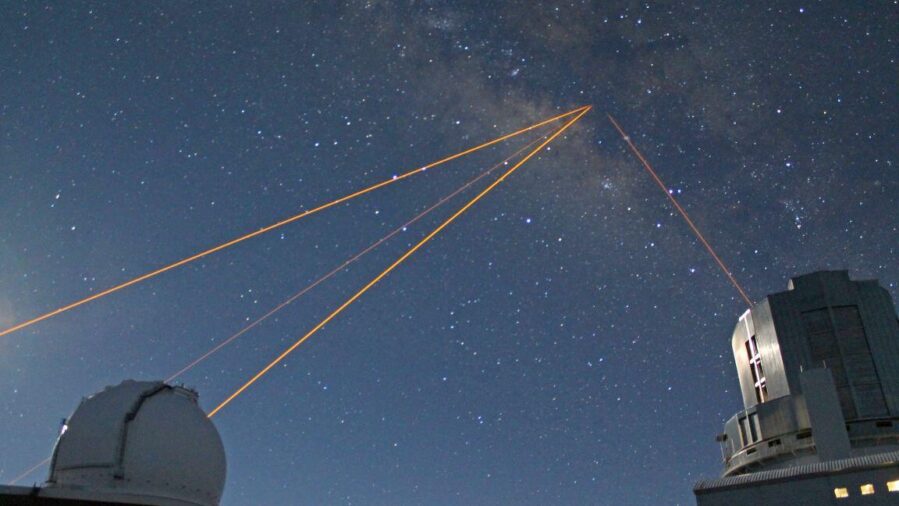
The result: images five times more precise than standard methods, revealing a lopsided disk of hydrogen gas spinning around a nearby star that no one knew was asymmetric. The photonic lantern made its debut on the Subaru Telescope in Hawaii, where it fed into an instrument with the ungainly name FIRST-PL.
Think of the lantern as a musical equalizer for light. It takes the lumpy, turbulent wavefront arriving from space and splits it into separate channels based on the shape of those fluctuations, preserving details that ordinary cameras would smear together. Then it splits each channel further by color. The outputs get reassembled computationally, and suddenly you have resolution that defies what a single telescope should be able to see.
“In astronomy, the sharpest image details are usually obtained by linking telescopes together,” said Yoo Jung Kim, a UCLA doctoral candidate and first author of the study published in Astrophysical Journal Letters. “But we did it with a single telescope by feeding its light into a specially designed optical fiber, called a photonic lantern.”
There is a hard physical limit to how sharp any telescope’s image can be, set by the wave nature of light itself. This is called the diffraction limit. Bigger telescopes push that limit further, which is why astronomers keep building larger and larger mirrors. Arrays of linked telescopes push it even further by effectively creating one giant aperture. But both approaches are expensive and logistically complex.
The photonic lantern offers a different route. By dissecting the incoming light into its fundamental spatial modes, the way a Fourier transform breaks down a signal into sine waves, it captures information that a normal detector would discard. The device itself was built by teams at the University of Sydney and the University of Central Florida, then integrated into the Subaru Coronagraphic Extreme Adaptive Optics system.
“This work demonstrates the potential of photonic technologies to enable new kinds of measurement in astronomy,” said Nemanja Jovanovic, a co-leader of the study at Caltech. “We are just getting started. The possibilities are truly exciting.”
Earth’s atmosphere is a problem. Turbulence makes stars twinkle, which is charming to poets and annoying to astronomers. The Subaru team used adaptive optics, a system of deformable mirrors that flexes in real time to cancel out atmospheric distortion. Even that was not enough.
The photonic lantern turned out to be so sensitive to wavefront ripples that Kim had to invent new data processing methods to filter out the residual turbulence. The target was a star called beta Canis Minor, about 162 light-years away in the constellation Canis Minor. It is surrounded by a disk of hydrogen gas rotating fast enough that the Doppler effect shifts its color: gas moving toward us glows bluer, gas moving away redder.
That color shift slightly changes where the light appears to come from, and by measuring those shifts with extreme precision, the team reconstructed the disk’s shape. “We need a very stable environment to measure and recover spatial information using this fiber. Even with adaptive optics, the photonic lantern was so sensitive to the wavefront fluctuations that I had to develop a new data processing technique to filter out the remaining atmospheric turbulence.”
What they found was unexpected: the disk is lopsided. One side is brighter or denser than the other, a detail invisible to conventional imaging. Why? No one knows yet. Astrophysicists who model these systems will now have to explain it.
The collaboration spanned institutions across three continents, including the University of Hawaii, the National Astronomical Observatory of Japan, Caltech, the University of Arizona, the Paris Observatory, and others. Sebastien Vievard, a faculty member at the University of Hawaii, emphasized the blend of cutting-edge photonics and precision engineering.
It is a reminder that sometimes the leap forward comes not from a bigger tool, but from a smarter way to use the one you have. The photonic lantern approach could soon be applied to study exoplanets, the dusty regions where planets form, or the jets erupting from black holes.
Michael Fitzgerald, a UCLA professor of physics and astronomy, noted that the team has been working to push past the diffraction limit frontier. They just took a significant step. If our reporting has informed or inspired you, please consider making a donation.
Every contribution, no matter the size, empowers us to continue delivering accurate, engaging, and trustworthy science and medical news. Independent journalism requires time, effort, and resources—your support ensures we can keep uncovering the stories that matter most to you. Join us in making knowledge accessible and impactful.
Thank you for standing with us!