**
The Pentagon Leans into Drone Swarms with a $100M Challenge
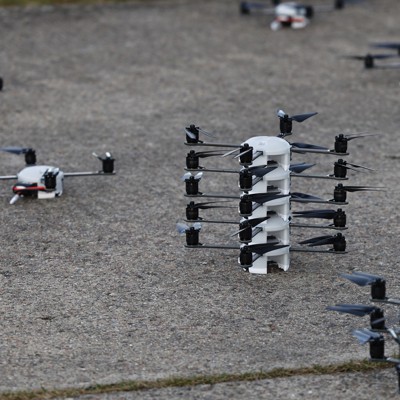
**The U.S. military is pushing the boundaries of artificial intelligence (AI) with its latest innovation challenge, aimed at making it easier for troops to command swarms of drones on land, sea, or in the air. The Defense Innovation Unit (DIU) has announced the Orchestrator Prize Challenge, a $100 million competition that seeks to develop technologies capable of directing groups of different drones from various manufacturers.
**A New Approach to Drone Warfare**
The U.S. military's evolving approach to AI is evident in its desire to move beyond simply purchasing warbots en masse and towards creating systems that can be easily controlled by commanders. "We want orchestrator technologies that allow humans to work the way they already command—through plain language that expresses desired effects, constraints, timing, and priorities—not by clicking through menus or programming behaviors," said Lt. Gen. Frank Donovan, leader of the Defense Autonomous Warfare Group (DAWG).
The DAWG is running the challenge in collaboration with DIU and the Navy. This latest initiative comes on the heels of the Replicator program, which aimed to procure thousands of small, highly autonomous drones quickly but missed its delivery deadline last August. Ukraine's military has set a new benchmark for drone warfare, having sent over 1 million drones to frontline units in recent years.
**The Challenge: Orchestrating Drone Swarms**
The $100 million challenge is centered around developing a "robust, scalable and vehicle-agnostic capability for understanding, tasking and coordinating autonomous systems at the fleet level." This concept of swarm robotics has its roots in a 1995 paper that explored the potential benefits of multiple robots working together. The U.S. military has been holding multi-robot challenges for over a decade, including the Navy's SWARM and LOCUST events.
However, these earlier events focused on simple naval maneuvers using a dozen or so autonomous boats or choreographed drone movements. The current challenge demands more—integrating multiple drones capable of autonomous decision-making and subordinating them to human judgment. This will be the ultimate test of how well humans and robotic swarms can understand each other.
**A Glimpse into the Future**
The Orchestrator Prize Challenge is a significant step towards realizing the potential of drone warfare. By pushing the boundaries of AI, the U.S. military aims to create systems that can adapt to complex battlefield scenarios and respond accordingly. As Lt. Gen. Donovan noted, "We want to make it easy for commanders to use multiple drones, not just one at a time." The challenge's outcome will undoubtedly shape the future of drone warfare and demonstrate the value of human-robot collaboration on the battlefield.
**NEXT STORY: Quantum Cameras Could Remake Space-Based Intelligence**
Stay tuned for more updates on this developing story and explore our coverage of emerging technologies in defense and aerospace.