**
Asus Revamps Liquid Metal Application on ROG Matrix RTX 5090 Cards
**In a move that's sure to spark interest among enthusiasts, Asus has revisited its liquid metal application on its flagship ROG Matrix RTX 5090 cards. The company had previously announced "product optimizations and enhancements" following reports of the high-end graphics cards being recalled.
**
A Closer Look at der8auer's Investigation
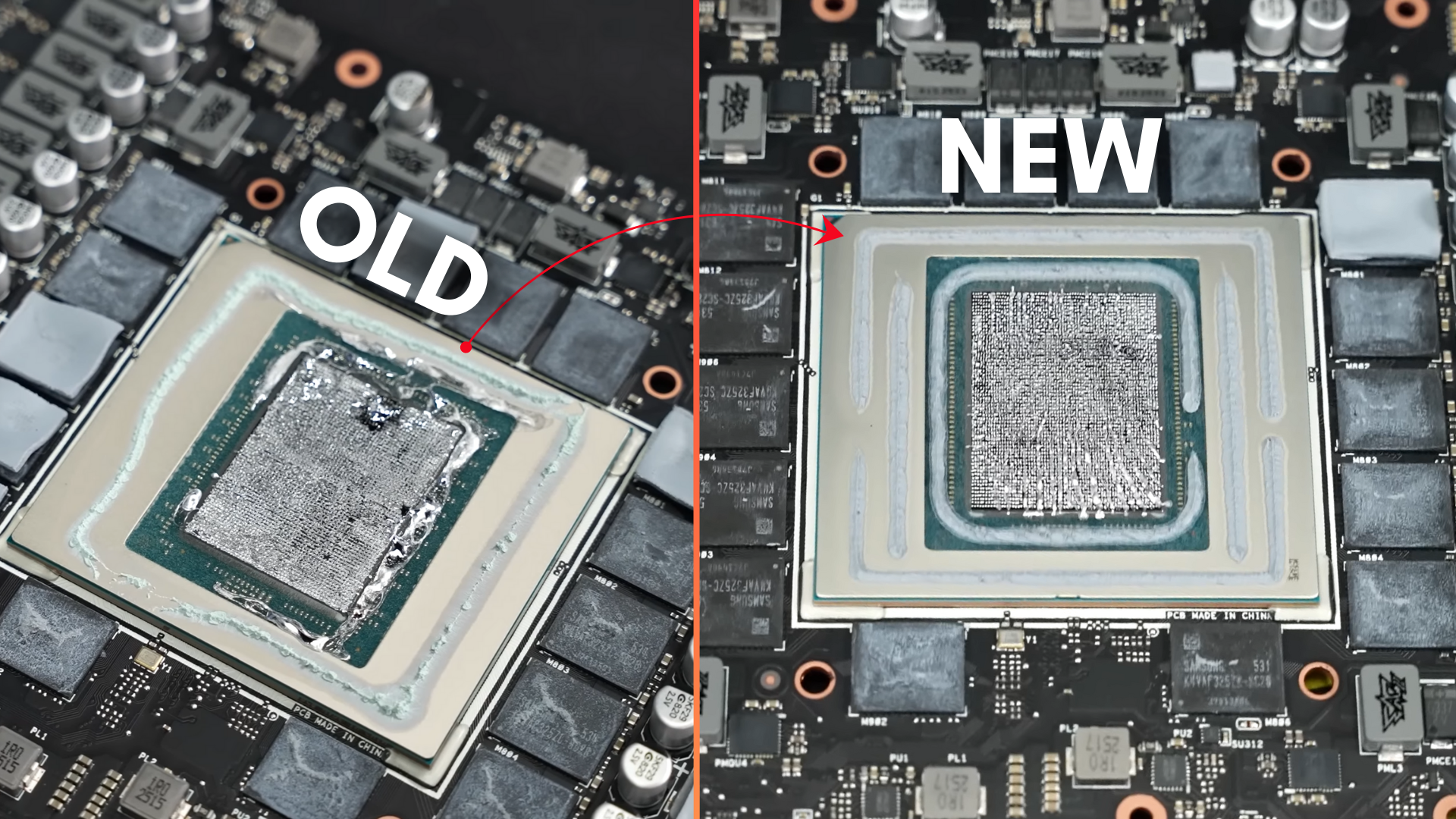
**Renowned hardware expert Roman 'der8bauer' Hartung recently delved into the matter, taking apart a retail version of the ROG Matrix RTX 5090 to examine the liquid metal application. His findings shed light on what Asus had done to rectify the issue. As it turns out, the recalled cards feature a new thermal paste pattern around the perimeter of the core, effectively containing the liquid metal.
**
Improved Thermal Interface Material (TIM) Application
**The changes are significant, and for good reason. Liquid metal is an excellent thermal interface material, but if it leaks from its application area, it can cause catastrophic short circuits, rendering the surrounding components useless. Asus has taken steps to mitigate this risk by incorporating additional safety measures.
**
The New Application Method
**Der8auer's disassembly revealed that the liquid metal now forms a seal with the thermal paste on the substrate, with two more lanes of it blocking the metal from escaping. This design prevents the liquid metal from leaking and causing damage to other components. Additionally, cutouts in the application ensure breathability and facilitate thermal expansion when the GPU is under heavy load.
**
A Look at the Liquid Metal Composition
**Further investigation using a Scanning Electron Microscope (SEM) revealed that Asus may have mixed silicon oil with the liquid metal to simplify mass production. This technique could help factories consistently replicate the TIM spread, ensuring reliable performance and longevity.
**
The Rest of the Card Remains Unchanged
**While these under-the-hood changes are noteworthy, it's worth noting that the rest of the card remains identical to its sample version – and by extension, very impressive. The GPU still pulls almost 800W in FurMark with slightly slower fan speeds than before, resulting in lower temperatures.
**
The Recall: A Costly Effort for Quality
**Asus' decision to recall these high-end cards demonstrates the company's commitment to quality and customer satisfaction. Even at a price point of $4,000, enthusiasts expect top-notch performance and reliability from their purchases. This costly effort will likely pay off in the long run, as customers are more likely to trust Asus with future purchases.
**
Additional Tidbits and News
**The video includes additional information on the development of a wired version of the WireView Pro tool, which would allow users to test any graphics card. Der8auer also shared some insights into the adapters provided by Asus for testing purposes.
Stay up-to-date with the latest news, reviews, and analysis from Tom's Hardware, delivered straight to your inbox:
**
****
Follow us on Google News:
** Tom's Hardware on Google News**
Add us as a preferred source:
** Get our latest news, analysis, & reviews in your feeds**
About the Author:
** Hassam Nasir is a die-hard hardware enthusiast with years of experience as a tech editor and writer. When he's not working on detailed CPU comparisons or general hardware news, you can find him tweaking his custom water-loop gaming rig or benchmarking the latest CPUs and GPUs for fun.