**Show HN: I Scrapped Honey's Affiliate Database and Now Sharing the Analysis**
Honey, a browser extension claiming to automatically find and apply coupon codes at checkout, has become one of the most widely-used shopping tools on the internet. With over 17 million users and acquired by PayPal for $4 billion in 2020, it has been touted as a "free money-saving tool." However, beneath the surface lies a sophisticated scheme that critics allege systematically diverts affiliate commissions from content creators and exploits online businesses.
**A Closer Look at Honey's Affiliate Database**
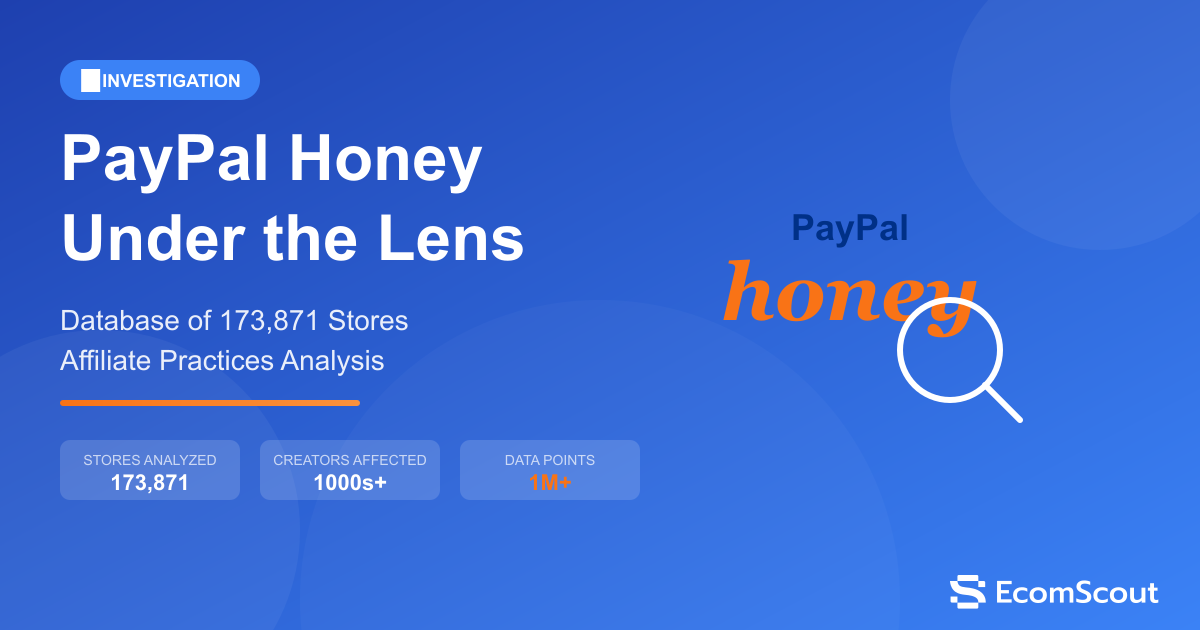
Our investigation obtained publicly available store data from Honey's extension, revealing disturbing patterns in their operation. We compiled a comprehensive dataset of 173.9K stores, including valuable store insights and ecommerce analytics into their business practices.
**The Alleged Scheme: Affiliate Hijacking through Last-Click Attribution**
Honey allegedly diverts commissions from content creators through affiliate hijacking or cookie stuffing. When a user clicks on an affiliate link, Honey inserts itself at the very last moment – even when it provides no value to the transaction – and claims the "last click" attribution. This means that Honey receives the commission instead of the creator who drove the sale.
**The Scope of Affected Businesses**
Our analysis shows that 84.4% of stores (146.7K out of 173.9K) have no affiliate partnership with Honey, meaning they were added to Honey's database without their knowledge or consent. This has a significant impact on store performance and revenue tracking across the industry.
**Cookie Stuffing and Last-Click Attribution Concerns**
Honey's approach is a sophisticated variant of cookie stuffing: waiting until the user is at checkout and then claiming the commission. This raises concerns about data collection, as users may not be aware that their browsing activity is being tracked.
**The Price Paid by PayPal: A Window into Consumer Shopping Behavior**
PayPal paid $4 billion for Honey's capabilities in collecting consumer shopping behavior across the entire internet. Each user is tracked across every online store they visit, including what products are viewed, compared, and purchased. This data is invaluable for targeted advertising, pricing strategies, and competitor analysis.
**Class Action Lawsuits: A Growing List of Accusations**
Following our investigation, PayPal and Honey have been hit with a wave of class action lawsuits accusing them of:
* Illegally intercepting and recording user communications and browsing activity * Unauthorized access to and modification of browser data and cookies * Allegedly diverting affiliate commissions from legitimate marketers and creators * Misrepresenting the service's benefits and data practices
**A Closer Look at the Lawsuits**
Some of the key plaintiffs include:
* **Gamers Nexus**, a prominent tech YouTube channel, serving as lead plaintiff in one class action lawsuit. * **MegaLag**, whose investigation exposed Honey's practices.
**Protecting Your Affiliate Cookies from Being Hijacked**
As users become increasingly aware of their data being collected and used without consent, it is essential to take steps to protect your affiliate cookies. This can include using a VPN or ad blocker to limit tracking.
**Conclusion: A Complex Web of Allegations**
The allegations against Honey and PayPal raise significant concerns about the use of affiliate marketing, data collection, and user consent. As our investigation continues, we encourage readers to explore the full dataset of 173.9K stores and stay informed about this rapidly evolving situation.
Here are some possible ways to protect your affiliate cookies:
* **Use a VPN**: A virtual private network can help mask your IP address and limit tracking. * **Ad blockers**: Tools like uBlock Origin or AdGuard can block trackers and prevent cookie stuffing. * **Browser extensions**: Some browser extensions, such as Cookie AutoDelete or Privacy Badger, can automatically delete cookies after you close a browsing session.
We'll be keeping an eye on this story and providing updates as more information becomes available.