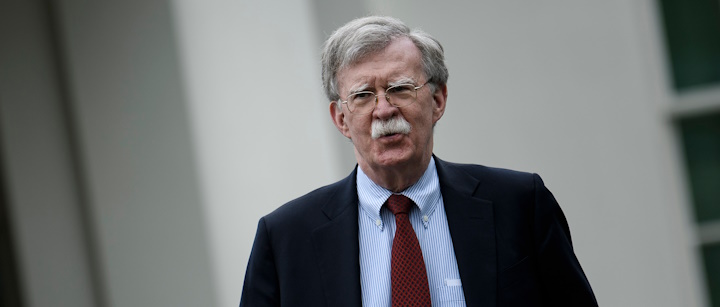
Breaking News: The Bolton Indictment Unveiled
A federal grand jury in Maryland on October 16 returned an indictment against former National Security Adviser John Bolton for mishandling classified national defense information obtained during his tenure in the first Trump administration. This is not the first time a prominent critic of President Donald Trump has been indicted; James Comey, the former FBI Director, and Letitia James, the New York Attorney General, have also faced federal charges in recent weeks.
Bolton, who was fired from his position as national security adviser by Trump in September 2019 after 17 months, released a statement claiming that he is the "latest target in weaponizing the Justice Department to charge those [Trump] deems to be his enemies." However, legal experts say that the government appears to have a strong case against Bolton.
The Indictment: A Detailed Look
The 26-page indictment alleges that Bolton "abused his position" as national security adviser by sharing more than a thousand pages of information about his day-to-day activities, including national defense and classified information, with two unauthorized individuals. After he was no longer permitted to do so, "Bolton also unlawfully retained documents, writings, and notes relating to the national defense, including information classified up to the TOP SECRET/SCI level," the indictment says.
SCI is an abbreviation for "sensitive compartmented information," which only people with proper security clearances can access. The indictment accuses Bolton of using personal, non-governmental email accounts and messaging applications to send his relatives "diary-like entries" that included top secret or sensitive details, which he was not allowed to do.
In addition, some entries with classified information "were printed and stored" at Bolton's home, and digital copies of some entries "were also stored on personal electronic devices" belonging to Bolton and others at that residence, the indictment says. The FBI recovered some of those materials when conducting a court-ordered search of his home on August 22.
The indictment also alleges that Bolton's personal email was hacked by someone "believed to be associated with" Iran who "gained unauthorized access to the classified and national defense information in that account." Bolton had informed the FBI of the hack in July 2021, but did not disclose that his email account had been used to transmit classified defense material.
Bolton's Response: A Claim of Political Motive
Bolton called his indictment political in a statement to reporters. "Now, I have become the latest target in weaponizing the Justice Department to charge those he deems to be his enemies with charges that were declined before or distort the facts," he said, referring to Trump.
However, some legal analysts say that the government appears to have a strong case against Bolton. "This indictment stands in stark contrast to the indictments against James Comey and Letitia James in its detailed recitation of the allegations and the serious nature of the charges," says Barbara McQuade, a professor from practice at the University of Michigan Law School and a former U.S. attorney.
Andrew Weissmann, a professor of practice at New York University Law School and a former FBI lawyer, also comments on the strength of the case against Bolton: "In many ways, it is unlike the Comey case and Letitia James case because it appears on the face of it to be stronger and more merited to bring."
The Charges Against Bolton
Bolton faces 18 criminal charges, including 10 counts of unlawful retention of classified defense information and eight counts of transmitting it. If convicted, he could get up to 10 years in prison for each criminal count.
Bolton's Defense: A Claim of Intimidation
Bolton pleaded not guilty to all 18 charges in an October 17 court appearance. His attorney, Abbe Lowell, claims that the charges against his client "stem from portions" of "personal diaries over his 45-year career – records that are unclassified, shared only with his immediate family, and known to the FBI as far back as 2021."
Bolton's defense team also argues that the indictment is about Trump's "intensive effort to intimidate his opponents, to ensure that he alone determines what is said about his conduct." Bolton promised to defend his "lawful conduct" in court and "expose" Trump's "abuse of power."
When asked about the indictment by reporters on October 16, Trump called Bolton a "bad guy," saying that it was "too bad." However, in a Fox News interview on October 19, he said that he thought the indictment was a "good thing."
A Look at the Legal Landscape
The case against Bolton stands out from other high-profile indictments of Trump rivals. While Comey and James were indicted by Lindsey Halligan, a former personal attorney for Trump, who obtained the indictments in her first three weeks on the job. The indictment against Bolton was presented to the grand jury by Thomas Sullivan, an assistant U.S. attorney for the District of Maryland.
This team of career prosecutors presents a stark contrast to the cases against Comey and James, which were obtained by Halligan in her early days as interim U.S. attorney for the Eastern District of Virginia.
The Verdict is Still Out
As the case unfolds, one thing is clear: John Bolton's indictment raises serious questions about national security and the handling of classified information. Whether he will be found guilty or not remains to be seen.